
Scented Ground
Strewing Herbs, Sacred Floors and the Old Ecology of Perfume

Executive summary
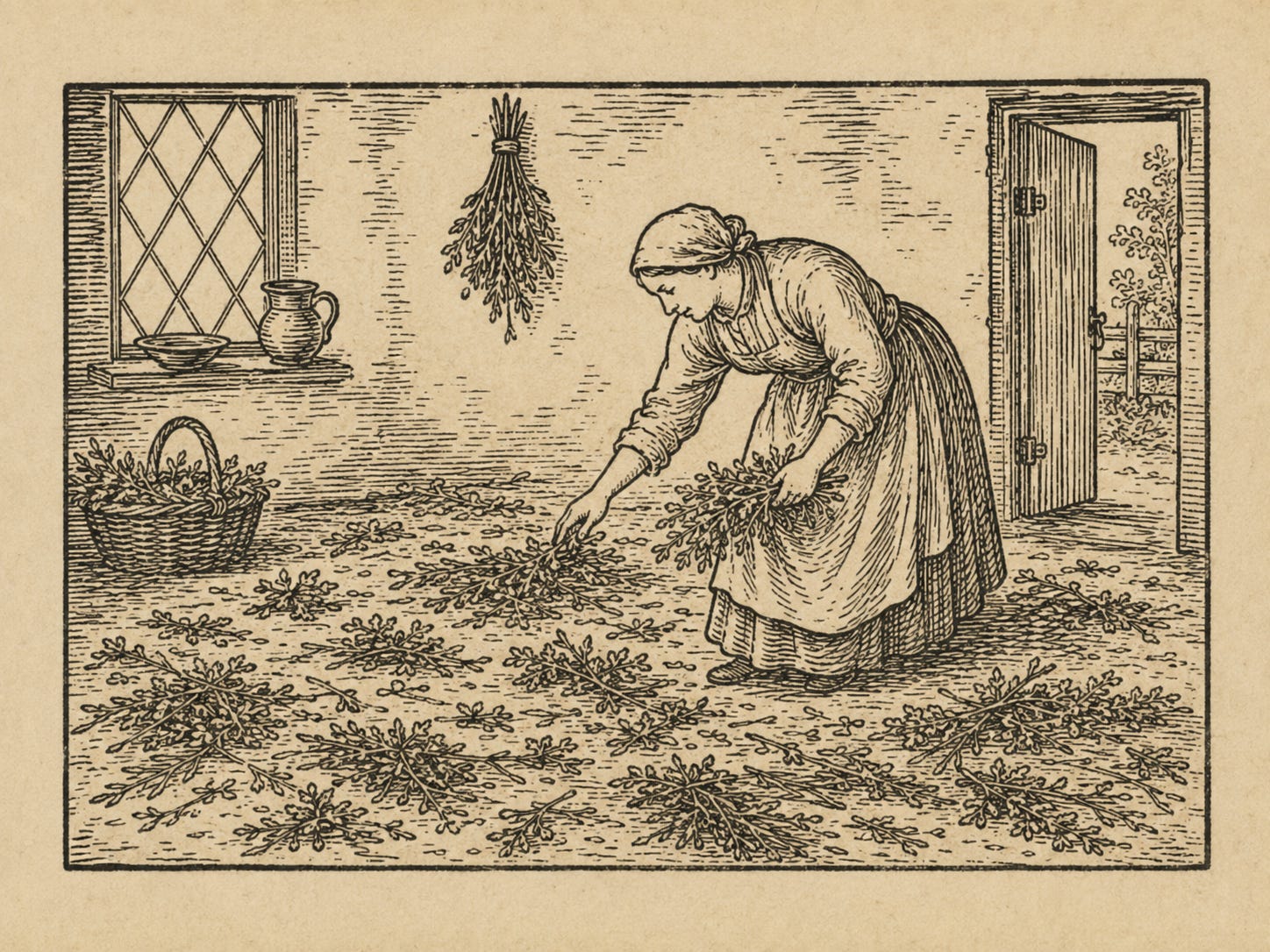
This report argues that strewing herbs are not an isolated Tudor curiosity but one historically visible human form of a broader cross-species practice, the placing of aromatic or otherwise active plant matter, underfoot, beneath bodies, in nests, or along ritual routes in order to alter ecology, scent, comfort, and meaning. In England, the best recoverable documentary core is indeed early modern, for example, Thomas Tusser’s 1580 list of “Strowing herbes of all sortes,” Gerard’s praise of meadowsweet for chambers and halls, Parkinson’s note about Queen Elizabeth’s preference for meadowsweet, and churchwardens’ records of rush-strewing. But once the frame widens, England becomes the best-documented node, not the whole subject. Comparable practices appear in Orthodox Pentecost greenery, Corpus Christi flower carpets, Guatemalan Holy Week alfombras, Kerala pookalam, and Ethiopian/Eritrean coffee ceremony flooring.
The comparative pattern is striking. In human settings, plant matter on the ground repeatedly does at least four jobs at once, it marks a threshold, modifies atmosphere, organises communal labour, and creates an intentionally temporary surface that is often crushed, walked over, or dispersed. In animal settings, the closest parallels are ecological rather than symbolic, for example, birds adding aromatic herbs to nests, wood ants incorporating resin, honey bees building propolis envelopes, woodrats using bay leaves, and some primates rubbing medicinal plants on the body or selecting nest/bedding materials with plausible hygienic effects. The exact behaviours differ, but the family resemblance is real, as in, organisms recruit plant chemistry to reshape lived space.
Footfall as a Diffuser
Mechanical damage causes plants to emit green leaf volatiles and, in species with storage structures such as oil glands, resin ducts, or glandular trichomes, crushing can sharply alter the rate and profile of volatile release. That does not prove every historical deodorising or anti-parasite claim, but it makes the basic sensory logic of strewn floors entirely plausible. The strongest evidence now available supports three claims. Crushed plant material can rapidly release scent; some aromatic plants and resins can reduce parasite or microbial pressure in nest-like settings; and ritual ground-coverings derive much of their force from ephemerality and deliberate trampling.
How do humans and other animals use plant matter to make atmosphere liveable, sacred, festive, protective, or socially legible?
Study and scope
The study is deliberately expansive. A recoverable family of practices exists in which botanical material is deliberately placed beneath bodies, beneath processions, or within sleeping/ritual environments so as to modify a space’s smell, thermal feel, microbial or parasitic burden, symbolic charge, or social atmosphere. In human history, strewing herbs are one branch of that family. In animal behaviour, the nearest analogues appear under the broader headings of nest protection, social immunity, self-medication, and environmental self-care.
English core and ritual geography
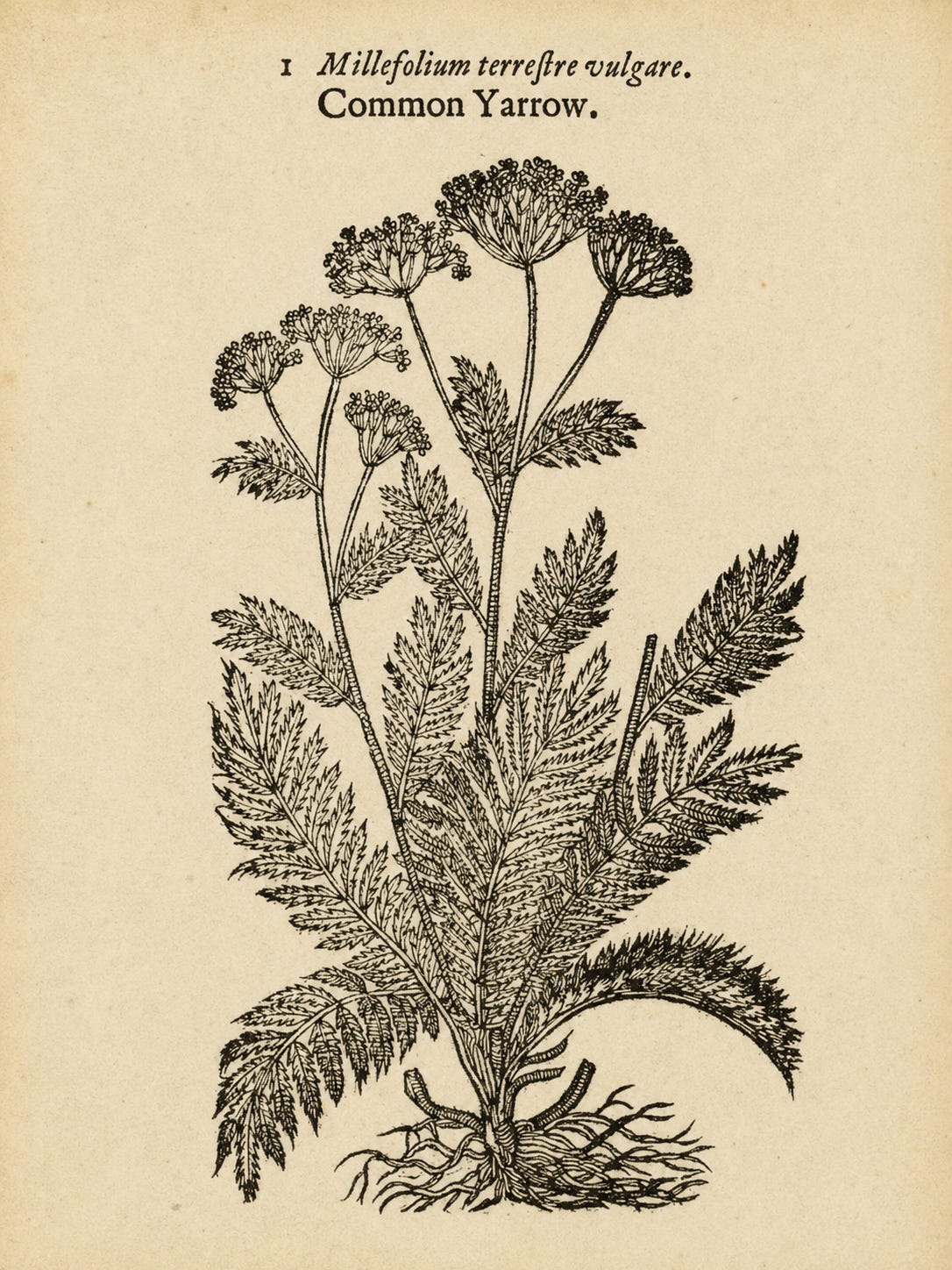
The English core is still the cleanest place to begin. Tusser’s 1580 Fiue Hundred Pointes of Good Husbandrie includes a discrete section headed “Strowing herbes of all sortes”, listing basil, balm, chamomile, costmary, cowslips and paggles, daisies, sweet fennel, germander, hyssop, lavender, lavender spike, lavender cotton, knotted marjoram, mawdelin, pennyroyal, roses, red mints, sage, tansy, violets, and winter savoury. That list gives us something unusual in vernacular domestic history, a recognisable canon rather than a vague custom. But it also contains taxonomic uncertainty. Tusser’s editor notes that “Mawdelin” had naming overlap with costmary, while “paggles” could refer to cowslip or other spring flowers in regional usage.
Gerard and Parkinson sharpen the sensory and social profile of the practice. Gerard states that meadowsweet’s leaves and flowers “farre excell all other strowing herbes” for houses, chambers, halls, and banqueting houses, because the smell “makes the heart merrie”; later summaries of Parkinson preserve his remark that Queen Elizabeth “did more desire it than any other sweet herbe to strew her chambers withal.” That pairing matters because it shows strewing was not merely a poor household’s substitute for flooring. It could also be elite atmospheric design.
The same period also preserves a second English strand, rush-bearing. The churchwardens’ accounts of St Mary-at-Hill preserve payments for rushes in 1493 and 1504, and later antiquarian and local-historical summaries note similar expenditures at Kirkham in 1604 and 1631, ceasing when the church floor was flagged. National Trust material on Grasmere describes rushbearing as originally a practical response to earthen church floors used for cleanliness and insulation, later surviving as ceremony. The secure documentary point, then, is that church floors really were renewed with plant material; the less secure point is how routinely that material was mixed with sweet flag and herbs. That admixture appears often in later descriptions, but the most primary account books more often mention rushes than detailed aromatic recipes.
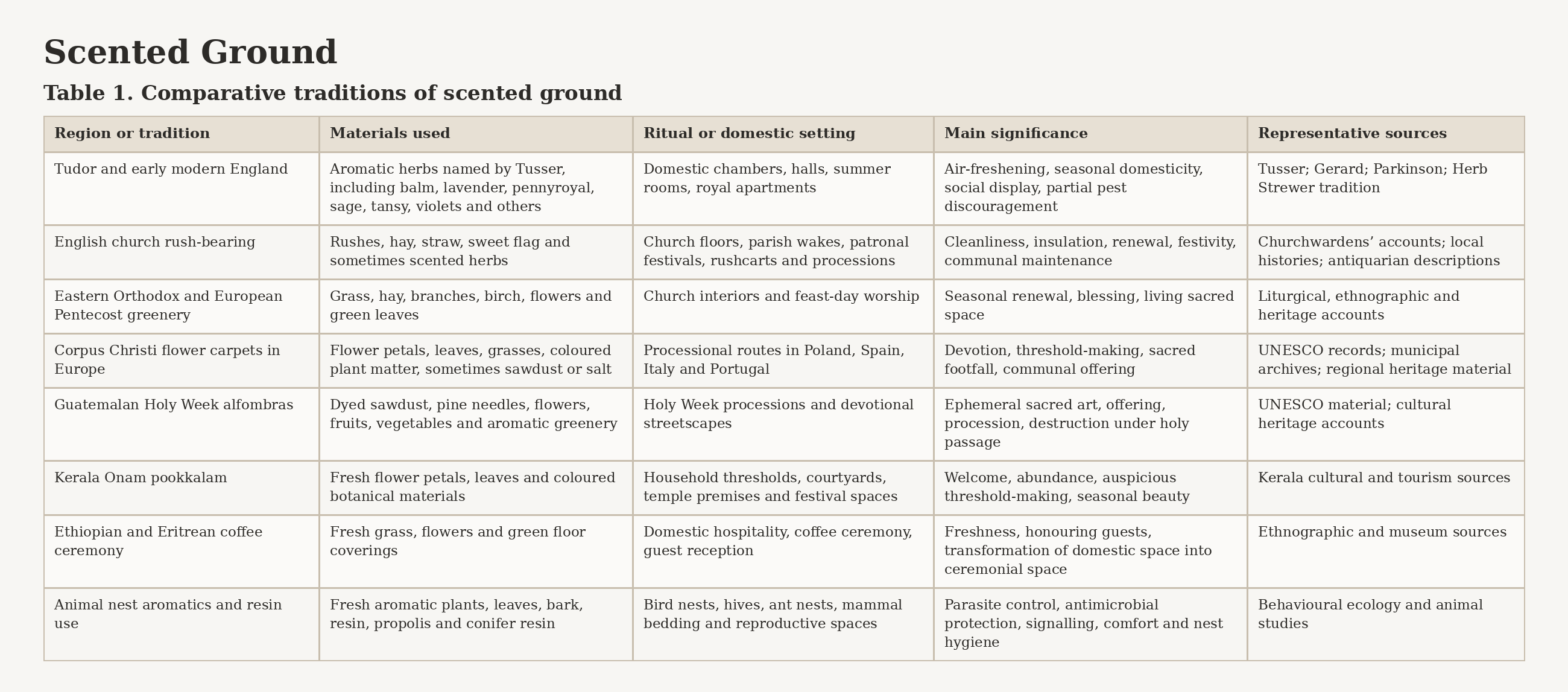
Once the lens moves beyond England, a wider European ritual geography appears. In Orthodox Pentecost practice, churches are decorated with greenery, flowers, and branches, and some traditions explicitly place grass on the floor; the symbolism is renewal, blossoming life, and the Holy Spirit’s vivifying force. In Roman Catholic contexts, flower carpets for Corpus Christi processions survive or have been revived in multiple places, for example, UNESCO recognises the Spycimierz tradition in Poland; official Spanish tourism pages describe flower-petal carpets in Sitges that are later passed over by the procession. In Ponteareas and Ares in Galicia, floral carpets combine art, fragrance, communal harvesting, and Eucharistic devotion; Visit Lazio describes Gerano’s infiorata as a floral carpet tradition dating from 1740, with the procession passing over the flowers.
Outside Europe, the same structural logic persists in different religious and domestic settings. UNESCO describes Guatemalan Holy Week as including the creation of carpets as part of the country’s major ritual complex, while museum and press accounts from Antigua describe alfombras made from dyed sawdust, flowers, pine needles, fruits, and other natural materials, laid precisely so that sacred processions will pass over and destroy them. Kerala Tourism describes pookkalam as a floral carpet laid in front yards and at entrances during Onam to welcome Mahabali; the designs expand over the festival’s ten days and concentrate prosperity, hospitality, and threshold symbolism. In Ethiopia and Eritrea, official and museum-style accounts of the coffee ceremony describe fresh grass spread on the floor, often with flowers and incense, to create an atmosphere of welcome, abundance, and social attention.
The geographical pattern matters because it shows that “strewing herbs” are best understood as one historically specific instance of a much larger phenomenon, that is, ground-making with plants. The materials vary, rushes, petals, leaves, grasses, sawdust, pine needles, resins, but the social grammar repeats with remarkable consistency, such as, preparation, display, fragrance, collective making, and eventual trampling or dispersal.
The comparative table below gathers the main human traditions of scented ground-making. It is not a claim of exhaustive global coverage; it is a visual guide to the traditions for which the source base is strongest here
Cross-species parallels
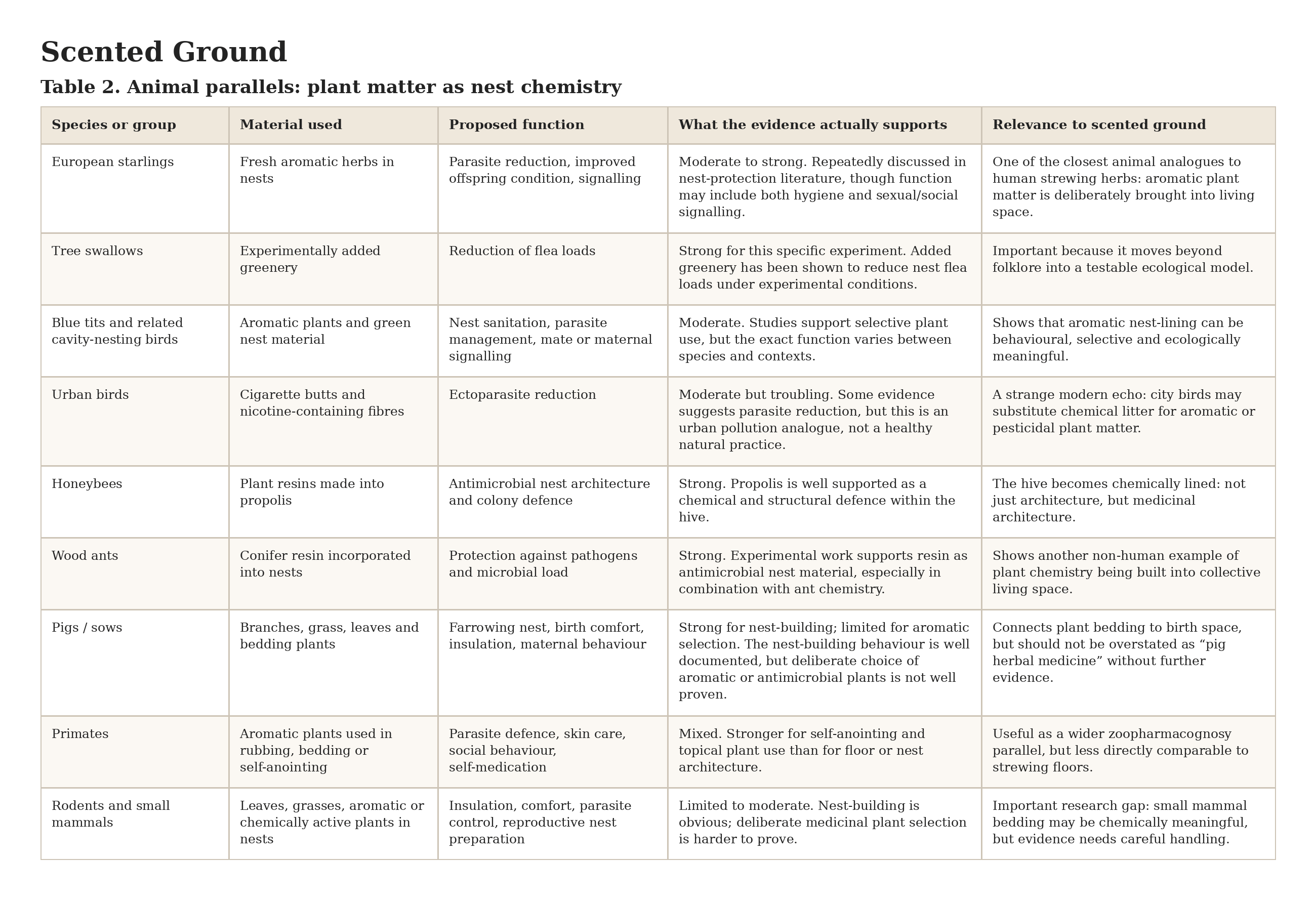
The animal evidence does not show a single universal behaviour. What it shows is a cluster of strategies in which animals use external materials, especially plant matter and resins, to manage surroundings. In birds, the classic framework is the nest protection hypothesis, that is, fresh aromatic greenery may reduce parasite or pathogen burden. A major review concludes that the evidence is mixed rather than decisive; some studies find benefits, others do not. That mixedness is important, because it makes the animal parallels more rigorous, not less romantic.
Within that mixed bird literature, some results are especially relevant to “scented ground”. European starlings actively include green plants rich in volatiles; early experiments found improved nestling condition without a clean reduction in ectoparasites, while later work suggested herbs can improve incubation and parental behaviour. In tree swallows, experimental greenery additions reduced flea loads. In blue tits, aromatic plants have been linked to lower bacterial richness and density on chicks, and recent experimental work reported fewer ticks and better haematological condition in nests supplemented with aromatic fragments, even though fledging success did not change. The pattern is therefore not “herbs always clean nests”, but “green aromatic material can sometimes change nest ecology or offspring condition, but results vary by species, parasite, and design.”
In social insects, the case is stronger. Reviews of honey bee health describe the nest’s propolis envelope as an antimicrobial layer and a form of social immunity. In wood ants, classic and later studies show that ants carry conifer resin into nests and that resin use can protect brood against pathogens; another study found that ants enhance the antimicrobial effect by applying formic acid to the resin. Here the analogy to strewing is not symbolic but architectural. Plant chemistry becomes part of the built environment.
Rodents provide a narrower but extremely telling parallel. A behavioural ecology study on dusky-footed woodrats found that nibbled California bay leaves reduced flea-larval survival, supporting the idea of nest fumigation with volatile foliage. Broader mammalian reviews still cite woodrats as a distinctive example of environmental self-medication. By contrast, evidence for domestic pigs points strongly to the importance of plant-based nest-building before farrowing, but the literature supports structural, thermal, and behavioural welfare benefits much more clearly than any specific aromatic or medicinal selection. In other words, pigs definitely make vegetal birth-nests; they do not yet provide strong evidence for herb-selected fumigation.
Primates complicate the picture in useful ways. The clearest primate parallels are usually topical or ingestive, not flooring-based. Bornean orangutans have been observed chewing Dracaena cantleyi and rubbing the lather onto their limbs; pharmacological analyses support anti-inflammatory activity. A well-documented Sumatran orangutan later applied a biologically active plant to a facial wound. Reviews of primate anointing behaviour likewise interpret some plant or arthropod rubbing as repellent or medicinal. Chimpanzees also select nesting trees for bedding quality, and one nesting study incorporated spatial repellent activity into the analysis, though the causal role of repellency remains inferential. These behaviours do not equal human flower carpets or strewn floors, but they do strengthen the broader thesis that organisms use external natural materials to re-engineer bodily or sleeping environments.
Mechanisms and meanings
The mechanistic bridge between strewn floors and animal nest protection begins with basic plant physiology. Mechanical damage, cutting, puncturing, scratching, tearing, crushing underfoot, can trigger rapid emission of green leaf volatiles and other damage-induced volatiles. A recent review describes GLVs as six-carbon volatiles produced after wounding, while a 2025 comparative study found that controlled mechanical injury changes emission rates of isoprenoids and aromatic compounds across many species, especially where plants possess storage structures such as oil glands, resin ducts, or glandular trichomes. In plain terms, this means, bruised botanicals smell more because damage changes what escapes into the air.
From that, one may make a careful inference. Historical footfall was a release technology. The inference is well supported by plant science and by the form of the practices themselves, but it remains an inference because nobody in the sixteenth century was measuring chamber volatilomes. Still, once volatile-emitting leaves, petals, rushes, and grasses are scattered on floors or routes, every step becomes a small act of extraction. This is especially plausible for oil-rich or highly bruisable material, and increasingly plausible for mixed botanical surfaces in enclosed or semi-enclosed spaces.
Meaning works alongside mechanism, not after it. Orthodox Pentecost greenery is explicitly interpreted as renewal and spiritual blossoming. Corpus Christi and Holy Week carpets are devotional offerings whose destruction under the procession is part of their point, which is, value is realised in passage, not preservation. Onam’s pookkalam are laid at entrances and front yards to welcome Mahabali and figure prosperity. In Ethiopian and Eritrean coffee ceremony, grass and flowers on the floor convert the sitting area into a space of hospitality and abundance. These are not merely deodorising technologies. They are atmosphere-making technologies in which scent, sight, labour, and symbolism are fused.
For teaching purposes, the most productive conceptual formula is that the floor becomes a fragrance object. A material field activated by approach, occupation, kneeling, procession, and trampling. That formula also helps distinguish three evidential layers that are often muddled together, they are, a sensory layer of volatile release, an ecological layer of partial parasite or microbial modulation, and a ritual layer in which plants signify sanctity, welcome, mourning, prosperity, or divine presence. The traditions discussed here almost always combine at least two of those layers, and often all three.
The table below links the main claims in this field to the kinds of evidence that presently support them. It is meant as a guide to rigour, for example, some claims rest on documents, some on ecology, some on symbolism, and some on a combination.
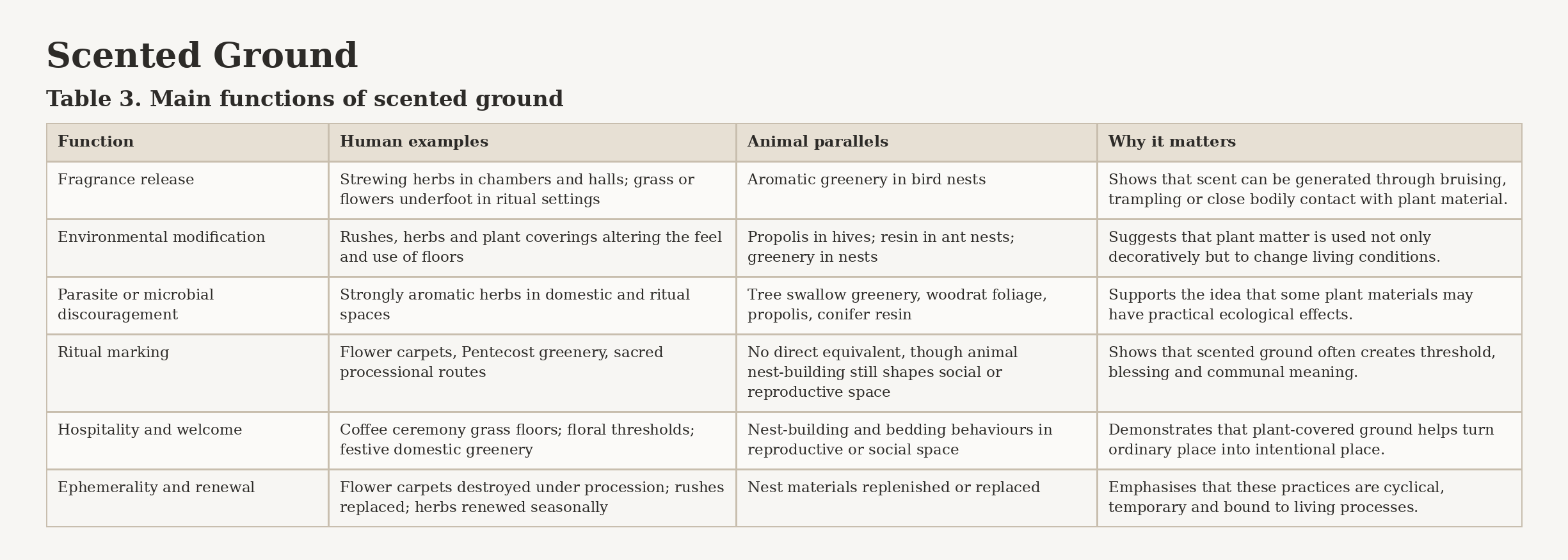
The larger point of this study is not simply that people once covered floors with herbs, rushes, grasses or flowers. It is that scent, plant matter and the aesthetic ordering of space appear to belong very deeply to the behaviour of living beings. Humans laid leaves, petals, rushes and aromatic plants beneath feet, bodies, processions and guests. Birds, insects and some mammals draw plant matter, resin or aromatic material into nests, hives and bedding places. The meanings are not identical, and the evidence has to be handled carefully, yet the pattern is difficult to dismiss. Living beings repeatedly use plants to make space more habitable, more legible, more protective and more charged with meaning.
For perfumery, this matters. It suggests that fragrance did not begin as a luxury object separated from life. It began as atmosphere, bedding, threshold, worship, welcome, birth, mourning and dwelling. Before scent was enclosed in bottles, it was underfoot, around the body, in the chamber, in the nest and along the road of procession. The aesthetic impulse was therefore not superficial. It was practical, sensory, ecological and instinctive.
There is also a sharper modern implication. Earlier forms of aromatic ground-making belonged to a world in which daily life still returned material to the earth. Rushes, straw, leaves, petals, food remains, bodily traces and the dead all moved, however imperfectly, through cycles of use and decay. Modern life has largely broken that intimacy. We clean, seal, extract, package and remove. We still consume the botanical world, but we often return almost nothing to it.
This is where the animal parallels become more than curiosity. Bees build with resin. Ants carry resin into their nests. Birds bring aromatic leaves into their nesting spaces. Their lives remain entangled with the materials around them. Human beings once lived in a less separated way as well. Strewing herbs and scented floors are small historical traces of that older relation. They remind us that beauty was once compostable, fragrance was once architectural, and domestic life was once part of a wider cycle of return.
The conclusion is not meant to be nostalgic. Earthen floors, rushes and animal bedding were not pure or romantic, and historical life carried real dirt, disease and hardship. The value of this study is that it shows another way to think about scent. Fragrance is one way living beings negotiate space, matter, memory, risk and belonging. Strewing herbs mark one place where perfume, ecology and ritual meet.
Readers who love this kind of conversation around plants, scent, history and natural perfumery are warmly invited to join the free Natural Botanical Perfumers Club
Prioritised sources
The source trail for this study is best understood in layers, starting with the most foundational.
Primary and near-primary English texts and records
Thomas Tusser, Fiue Hundred Pointes of Good Husbandrie, essential for the recoverable Tudor strewing canon, including the explicit heading “Strowing herbes of all sortes” and the 21-item list.
John Gerard, Herball, especially important for meadowsweet as a chamber and hall strewing herb, and for sweet woodruff’s domestic air-freshening use.
John Parkinson, preserved in later searchable compilations, especially for meadowsweet and Elizabethan chamber strewing.
St Mary-at-Hill churchwardens’ accounts and later rush-bearing record chains, foundational for church-floor rush renewal.
Official heritage and cultural sources for the wider ritual geography
UNESCO, Flower carpets tradition for Corpus Christi processions, the strongest official source for the Polish Corpus Christi carpet tradition.
UNESCO, Holy Week in Guatemala, official baseline for the Guatemalan Holy Week complex that includes carpet-making.
Kerala Tourism official pages on Onam and pookkalam, the clearest official source on floral carpets in front yards and entrances.
Spain.info, Rías Baixas tourism, Galicia tourism, Visit Lazio, and municipal or tourism pages from Portugal and Madeira, useful official sources for European flower-carpet variants outside UNESCO inscription.
Smithsonian and UNESCO material on the Ethiopian coffee ceremony, the strongest official route into the grass-on-floor hospitality tradition.
Peer-reviewed animal behaviour and ecological studies
Scott-Baumann et al. review of the nest protection hypothesis, useful for understanding why avian aromatic-nest evidence remains mixed.
Shutler et al. on tree swallows, particularly valuable because greenery experimentally reduced flea loads.
Mennerat et al. and recent tit studies, useful for bacterial and physiological effects in blue tits and great tits.
Simone-Finstrom et al. on propolis and bee social immunity, and Chapuisat and colleagues on wood-ant resin use, the strongest insect literature for environmental plant chemistry.
Hemmes et al. on woodrats and California bay, crucial for a mammalian “nest fumigation” parallel.
Orangutan and primate self-medication papers, useful for the topical and bodily branch of the wider study.
Plant-science and mechanism sources
Reviews and experimental papers on green leaf volatiles and mechanical injury, central for the “footfall as diffuser” mechanism.
Reviews of plant-derived repellents and volatile-mediated defence, useful for connecting historical plausibility with modern chemistry.
Safety sources for reconstruction work
NIH LiverTox on pennyroyal oil, essential caution if historical herbs are re-imagined using modern concentrated oils.
EMA public statements on thujone, pulegone, menthofuran and asarone, important when moving from fresh or dried plant material to extracts, oils or medicinal-style applications.
Source links
The Project Gutenberg eBook of Fiue Hundred Pointes of Good Husbandrie, by Thomas Tusser
https://www.gutenberg.org/files/51764/51764-h/51764-h.htm
Corpus Christi in Sitges, Spain.info
https://www.spain.info/en/calendar/corpus-christi-sitges/
Green Leaf Volatiles, The Forefront of Plant Responses
https://academic.oup.com/pcp/article/63/10/1378/6658151
Animal medical systems from Apis to apes, PMC, NIH
https://pmc.ncbi.nlm.nih.gov/articles/PMC12586310/
Meadowsweet, The Hazel Tree
https://thehazeltree.co.uk/2019/08/16/meadowsweet/
The medieval records of a London City church
https://www.british-history.ac.uk/early-eng-text-soc/vol128
Why Do We Decorate Churches with Grass, Flowers and Tree Branches on Pentecost?
https://www.pravmir.com/why-do-we-decorate-churches-with-grass-flowers-and-tree-branches-on-pentecost/
Holy Week in Guatemala, UNESCO Intangible Cultural Heritage
https://ich.unesco.org/en/RL/holy-week-in-guatemala-01854
Flower carpets tradition for Corpus Christi processions, UNESCO Intangible Cultural Heritage
https://ich.unesco.org/en/8b-representative-list-01191?call=slideshow&id=01743&include=slideshow_inc.php&mode=scroll&width=620
The Infiorata di Gerano is a UNESCO Candidate, Visit Lazio
https://www.visitlazio.com/en/the-infiorata-di-gerano-is-a-unesco-candidate/
The Procession, São Brás de Alportel Municipality
https://www.cm-sbras.pt/pt/menu/947/the-procession.aspx
Pookkalam, Onam Festival, Kerala Tourism
https://www.keralatourism.org/kerala-article/2021/pookkalam-onam/1104
Coffee pot, Smithsonian Institution
https://www.si.edu/object/coffee-pot%3Anmah_1894629
Does inclusion of fresh green plant material in birds’ nests function in ectoparasite control?
https://pubmed.ncbi.nlm.nih.gov/25804728/
Green plants in starling nests, effects on nestlings
https://pubmed.ncbi.nlm.nih.gov/10675252/
Propolis Counteracts Some Threats to Honey Bee Health, PMC
https://pmc.ncbi.nlm.nih.gov/articles/PMC5492060/
Use of California bay foliage by wood rats for possible fumigation of nest-borne ectoparasites
https://www.researchgate.net/publication/46511858_Use_of_California_bay_foliage_by_wood_rats_for_possible_fumigation_of_nest-borne_ectoparasites
Self-medication by orang-utans using bioactive properties of Dracaena cantleyi, PMC
https://pmc.ncbi.nlm.nih.gov/articles/PMC5709421/
Experimental addition of greenery reduces flea loads in nests of a non-greenery-using bird
https://nsojournals.onlinelibrary.wiley.com/doi/abs/10.1111/j.2007.0908-8857.04015.x
Aromatic plants in nests of the blue tit Cyanistes caeruleus protect chicks from bacteria
https://pubmed.ncbi.nlm.nih.gov/19633988/
Wood ants use resin to protect themselves against pathogens, PMC
https://pmc.ncbi.nlm.nih.gov/articles/PMC2275180/
Sow behaviour, parturition process and management in free farrowing systems, PMC
https://pmc.ncbi.nlm.nih.gov/articles/PMC13085361/
Chimpanzees select comfortable nesting tree species
https://www.nature.com/articles/s41598-023-44192-6
Impacts of Mechanical Injury on Volatile Emission Rate and Profile from Plant Leaves
https://www.mdpi.com/2223-7747/14/5/821
Full text of The Book of Herbs
https://archive.org/stream/cu31924073899373/cu31924073899373_djvu.txt
Essential Oils as Repellents against Arthropods, PMC
https://pmc.ncbi.nlm.nih.gov/articles/PMC6189689/
Pennyroyal Oil, LiverTox, NCBI Bookshelf
https://www.ncbi.nlm.nih.gov/books/NBK548673/
Public statement on the use of herbal medicinal products containing thujone, European Medicines Agency
https://www.ema.europa.eu/en/documents/scientific-guideline/public-statement-use-herbal-medicinal-products-containing-thujone-revision-1_en.pdf
This is fantastic, and is my new favorite article. I'd recently been thinking about strewing herbs, balm in particular, and was pondering an experiment of my own; Melissa officinalis being one of the few herbs I know for certain is safe for housecats, I have created "wallowing boxes" for my cats to roll around in to help in repelling fleas. My cats adore lemon balm and I haven't got a system to measure whether they roll in it because it helps with fleas or because they just enjoy it, but now I'm encouraged to try a bigger experiment next year once I've got more plants established!
I'm always intrigued to learn about the herbal practices of other cultures, and I'm glad to have learned a few from this article. And an amusing take resulted from reading...I suddenly realized, and said aloud, "Flagstones!" I've known and used that word all my life without wondering about its origin, but it's great to stumble across such revelations and makes a convenient segue into discussion about strewing, should the term arise. :)
Scented ground perfume is a simple way to add a lovely fragrance to your surroundings. It gives a fresh and peaceful vibe that lasts for a while.